Jesus and the Fall Feasts of the LORD

What do the holidays of Leviticus 23 speak to us about Messiah?
Preached on Sept 13, 2026, the 16th Sunday after Pentecost / Rosh Hashana II 2026 at St. Luke's Anglican Church in Copley, OH.
L’shana tova! Happy New Year!
Yes, we’re in the first days of the new year on the Hebrew calendar and at the start of Judaism’s high holidays.
But before we more talk about that, let’s jump into Romans 14 from today's assigned readings.
5 One person esteems one day as better than another, while another esteems all days alike. Each one should be fully convinced in his own mind. 6 The one who observes the day, observes it in honor of the Lord. The one who eats, eats in honor of the Lord, since he gives thanks to God, while the one who abstains, abstains in honor of the Lord and gives thanks to God.
Who were the Romans? Why was Paul writing to them?
The church in Rome was not founded by Paul. In fact, he’d never been there when he wrote this letter. The congregation was likely founded by Jewish believers who had been in Jerusalem for the Feast of Weeks, which the Greek-speaking Jews called Pentecost. And like other churches we see in Acts and in Paul’s letters, the congregation was mixed – both Jews and Gentiles together worshiping Jesus as Messiah and Lord.
Then in AD 49, Emperor Claudius expelled all the Jews from Rome. For about five years, there were no Jews in city Rome. When Claudius died in AD 54, the Jews began to return to the city and to the church. For five years, Gentiles ran the church, preached, and worshiped in ways comfortable for Romans and Greeks. Perhaps the keeping of the biblical feasts fell by the wayside. Certainly, nobody was keeping kosher. Then the Jewish believers returned, still fully Jewish, still keeping the ancient practices, some of them still keeping kosher.
Some of you here at St. Luke’s have been present for the ups and downs of church life. You have seen how church culture shifts when leadership changes or a substantial group of people move away. I’ve had some close-up looks at rector changes and the departure of congregational stalwarts. Change is hard. Relationships are strained, sometimes rather quickly. So it seems it was at the church in Rome.
We’re not sure who told Paul about the Roman church’s troubles. One likely connection is Priscilla and Aquilla. Paul met them in Corinth after the couple were kicked out of Rome with the other Jews. Perhaps when they returned to Rome 5 years later, they encountered friction and remembered Paul had experience ministering to mixed congregations.
Paul expounds a lot of theological truths throughout Romans, explaining how Jesus saves both Jew and Gentile, reminding the Gentiles that God still loves the Israel that cannot see Jesus as Messiah. Then he gets to some practicalities of community life.
In Romans 14, Paul is alluding to the clash of calendars. Jews probably want to keep Sabbath and the biblical feasts. The Romans don’t see a need for that. Maybe they think that all we need is to worship Jesus on Sunday, because that’s when the resurrection happened. These arguments have continued through church history into our time.
I agree with Paul that we must give each other grace to follow our personal convictions on these secondary and tertiary theological questions like what days we keep holy, what rules of life we follow. We should neither condemn people for when they keep Sabbath, or if they choose to keep kosher or some other form of abstaining, nor condemn those who feel free in Christ to not do those things.
Still, I do believe that the Feasts of the LORD, as the biblical holidays are called in Leviticus 23, have something to teach us Gentiles about Jesus.
So because the lectionary served us up this Romans 14 passage on Rosh Hashana, we will look at the three biblical fall feasts.
The 'Appointments' of the LORD
In Leviticus 23, we see seven sets of holidays. To call them all feasts is not quite right, though celebratory eating is ultimately attached to all of them. The word sometimes translated feast is really appointed time. These are the appointments of the LORD. These are the dates the LORD has set to meet with his people.
The seven holidays are Passover, the Feast of Unleavened Bread, the Feast of Firstfruits, the Feasts of Weeks (aka Pentecost), the Day of Blasting (Trumpets), Day of Atonement (Yom Kippur), and the Feasts of Booths (Tabernacles/Sukkot).
We see in the Gospels that Jesus died just before Passover and the start of the Feast of Unleavened Bread and rose back to life on the Feast of Firstfruits. And Acts 2 tells us that God poured out the Holy Spirit on the Jesus followers on the Feast of Weeks, what we call Pentecost.
If God acted in the life of Jesus on the four spring feasts from Leviticus 23, might the three fall feasts also speak something to us as we wait for Jesus’ return? Those of us connected to the Messianic Jewish communities do believe so.
Memorial of Blasting, aka Rosh Hashana
Last Friday night, our Jewish neighbors not only started the weekly Sabbath, but they also began Rosh Hashana, the Jewish New Year. Rosh Hashana is a newer name. In the Bible, it is called literally the Memorial of Blasting. Since trumpets are sounded at the start of each month, it has been understood that trumpet blasts also open the new year. That is why some call the holiday the Feast of Trumpets.
There is very little said about this holiday. The text doesn’t say what it’s a memorial for. It’s a day of rest and feasting with the LORD. Even with few details – or maybe because of the lack of details – several traditions have developed in Judaism.
What Exodus calls the seventh month was the first month in Babylon. So sometime during or after the Babylonian exile, the Day of Blasting gets called Rosh Hashanah, the Head of the Year. Blowing trumpets continue to be part of the holiday.
While the holiday is generally a time for joyful family gatherings, it also starts a season of introspection and repentance in preparing for the next holy day.
Ten days after the Day of Blasting is Yom Kippur, the Day of Atonement. On this day, the high priest would offer a sacrifice for the sins of all of Israel. It was the only day the high priest would go into the Holy of Holies in the tabernacle or temple, and he would sprinkle blood on the top of the Ark of the Covenant, also called the mercy seat.
Today, because there is no temple, the Jewish people focus on confession and repentance of sin and mark the day with a 25-hour fast.
The trumpet blasts of Rosh Hashana are heard as a call to wake from sin. The 10 days between Rosh Hashana and Yom Kippur are called the Days of Awe. These days are time of reconciling with those one has wronged and asking God for mercy and forgiveness.
Several of the prophets use the trumpet blast as a signal of God’s coming down to vindicate Israel, to regather the exiles, and execute final judgment (e.g. Isa 27:13, Zech 9:14, Joel 2).
Do we see the Day of Blasting and the Day of Atonement in the New Testament?
We don’t see the Day of Blastings or Trumpets specifically in the New Testament, but there are hints in both Matthew 24 and in 1 Corinthians 15. Jesus, in telling his disciples about the end of the age, says,
30 Then will appear in heaven the sign of the Son of Man, and then all the tribes of the earth will mourn, and they will see the Son of Man coming on the clouds of heaven with power and great glory. 31 And he will send out his angels with a loud trumpet-call, and they will gather his elect from the four winds, from one end of heaven to the other.
And Paul builds on this:
51 Behold! I tell you a mystery. We shall not all sleep, but we shall all be changed, 52 in a moment, in the twinkling of an eye, at the last trumpet. For the trumpet will sound, and the dead will be raised imperishable, and we shall be changed. (see also 1 Thess 4:16)
Judaism had and has this expectation of God coming down to gather scattered Israel, as foretold in the prophets. Jesus and Paul are telling us that this expectation will be fulfilled at the second coming of the Son of Man, Jesus’ favorite title for himself. Not only will the living be gathered to God but also the dead will be resurrected, as the Pharisees already expected.
Because of these links, sometimes people get carried away and try to predict the Second Coming. There is a long history of date setting. I love in a town with a whole historical site dedicated to the Harmonists, German Christians of the 19th century who sure Jesus was coming back in their time. He did not, and the community died out.
Just last year, because of the war between Israel and Iran, some guy said he knew Jesus was coming back Rosh Hashana 2025. Well, here we are a year later still waiting.
While we are expected to be watchful and understand the times and seasons, Jesus is also clear that no man knows the hour. Before his Ascension, he said only the Father knew. So it foolish for us to calculate and guess.
Day of Atonement
Where do we see Yom Kippur in the New Testament? The Gospel writers, particularly John, make clear that Jesus’ death by crucifixion is connected to Passover. Paul says that Jesus is our Passover lamb (1 Cor 5:7). Yet, as we touched on yesterday, the same New Testament writers – resting on Isaiah 52 & 53 – portray Jesus’ sacrificial death as a guilt offering that cleanses Israel and the nations from sin. That’s Yom Kippur language.
Happily, the writer of Hebrews makes the connections to the Day of Atonement in bright, bold lines. Hebrews unpacks how Jesus is the Great High Priest who intercedes for us in the heavenly tabernacle. The tabernacle that Moses built in Exodus was patterned after the heavenly patterns God showed him on Mount Sinai (Exod 25:40, Heb 8:1-5).
In the Levitical system, people would come make offerings for their sins throughout the year. These gifts cleansed the people, but it was as if the tabernacle and its alter was collecting the sins of the people. Yom Kippur was the day that the tabernacle, and later the temple, itself was cleansed; all the people’s sin was removed from the camp so that God could continue to dwell with them.
So now, listen to what Hebrews 9 says:
11 But when Christ/Messiah appeared as a high priest of the good things that have come, then through the greater and more perfect tent … 12 he entered once for all into the holy places [in heaven], not by means of the blood of goats and calves but by means of his own blood, thus securing an eternal redemption. … 14 how much more will the blood of Christ, who through the eternal Spirit offered himself without blemish to God, purify our conscience from dead works to serve the living God. …
24 For Christ has entered, not into holy places made with hands, which are copies of the true things, but into heaven itself, now to appear in the presence of God on our behalf… 26 … he has appeared once for all at the end of the ages to put away sin by the sacrifice of himself.
Just like the sin of Israel would defile the tabernacle, so our sins and the sins of the whole world had defiled the tabernacle in heaven. Sit with that for a bit. Our sins reached even into heaven.
I remember the first time I went to the concentration camps in Poland. I remember stepping into a gas chamber for the first time. I saw the evidence of the Holocaust left behind by retreating Nazis. And I was overwhelmed. I cried out to God! Why?! How?! How could you?!
In that moment, I saw a vision of the cross, something like the paining by Salvador Dali that pictures the crucifixion from above. The difference in my vision was that I saw the whole earth at the foot of the cross, and the whole universe around. And I understood that Jesus’ sacrificial death is so broad and deep that it includes justice for millions upon millions murdered throughout time.
Jesus the Suffering Servant, our Great High Priest, has cleansed the eternal tabernacle and so the universe of all the sin that was, is, and will be. Those of us who have accepted his great gift are washed clean. As Hebrews 10:14 says, “For by a single offering he has perfected for all time those who are being sanctified.”
We who follow Jesus now rest in this truth. There will be a day when all Israel and all the nations will see and understand and, in God’s mercy, accept the great gift, too.
Feast of Booths/Sukkot
Now we come to the Feast of Booths, five days after the Day of Atonement. It’s called Sukkot in Hebrew.
The instruction in Leviticus 23 is
39 “On the fifteenth day of the seventh month, when you have gathered in the produce of the land, you shall celebrate the feast of the Lord seven days. On the first day shall be a solemn rest, and on the eighth day shall be a solemn rest. 40 And … you shall rejoice before the Lord your God seven days. 41 … It is a statute forever throughout your generations…. 42 You shall dwell in booths for seven days. All native Israelites shall dwell in booths, 43 that your generations may know that I made the people of Israel dwell in booths when I brought them out of the land of Egypt: I am the Lord your God.”
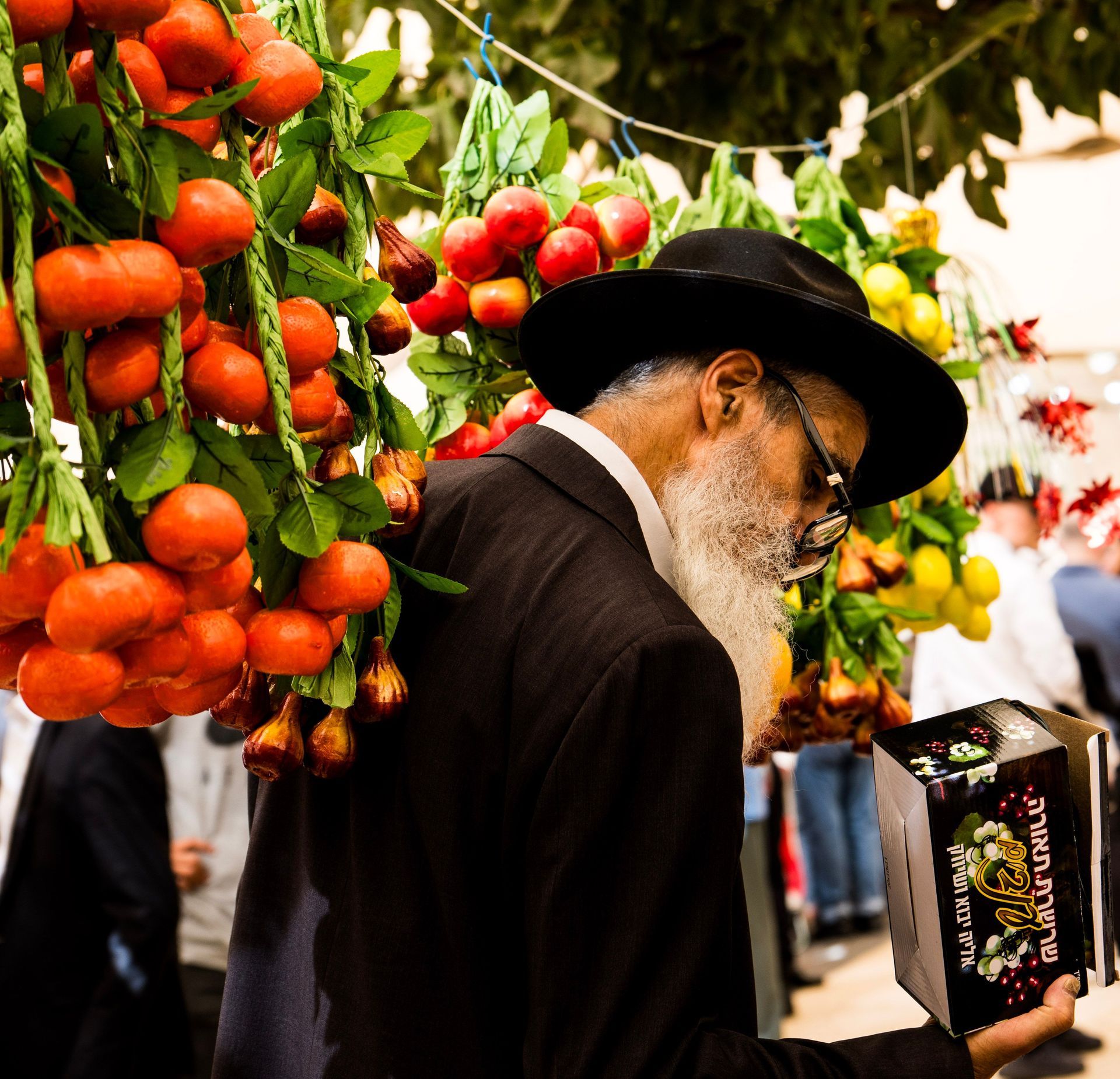
This may be my favorite festival, certainly when I’m in Jerusalem. People still build booths. If you drive through a Jewish neighborhood during the holiday, you may see booths and tents in yards and on balconies.
We see in Leviticus that this is a thanksgiving festival at the end of the harvest, it is a time of rejoicing, and it is a memorial for the Exodus. It is a way of acting out the Exodus in a different way than Passover. The Passover meal retells the story of how God judged Pharaoh and redeemed Israel from slavery in Egypt. Sukkot remembers God’s provision in the wilderness and how he dwelt with them in his own tent, the tabernacle.
Sukkot does appear in the New Testament. In John 7 we see Jesus going to Jerusalem for the Feast of Booths. The crowds are wondering if he’s the Messiah.
By the first century, a water ceremony had been added to the Sukkot celebration. The biblical feasts are quite connected to the seasons in Israel. The rainy season starts just as Sukkot is ending. And the dry season starts just as Passover comes. So as a way to pray for rain, the high priest would draw water from the Pool of Siloam and then a procession would follow him to the altar in the temple, where the water was poured out. This was done for the seven days of Sukkot. On the seventh day, the priest circled the altar seven times while the people sang, “Hosanna, Lord save us!”
The expectation was that God would send rain in the coming months, but also that he would pour out his Holy Spirit as promised in Joel 2 and Isaiah 12.
Back in John 7, it’s the last day of Sukkot, and the water ceremony is expected or has happened then
37 …Jesus stood up and cried out, “If anyone thirsts, let him come to me and drink. 38 Whoever believes in me, as the Scripture has said, ‘Out of his heart will flow rivers of living water.’”
Jesus on Nazareth, the Word of God made flesh who tabernacles with us, was answering their prayer: Here I am! I’ve come to save you!
And some believed and others didn’t, just as in our day.
The Feast of Tabernacles also points to a messianic future. In Zechariah 14, the nations around Israel gather to attack Jerusalem. And God himself comes and defeats the nations.
9 And the Lord will be king over all the earth. On that day the Lord will be one and his name one. … 16 Then everyone who survives of all the nations that have come against Jerusalem shall go up year after year to worship the King, the Lord of hosts, and to keep the Feast of Booths. 17 And if any of the families of the earth do not go up to Jerusalem to worship the King, the Lord of hosts, there will be no rain on them.
This has been read by some to mean that the Feast of Booths will continue to be celebrated in the next life. And some Christians celebrate the Feasts of Booth now to prophetically act out the worship of the God of Israel by the nations as depicted in Zechariah and Revelation.
Since 1980, an organization in Israel has hosted up to 5,000 Christians every year who come to celebrate the Feast of Booths with Israeli Jews. The highlight of the event is always the parade of nations. Christians bring flags from their home countries and walk a several mile route in Jerusalem. Israelis come to watch and celebrate with these Gentiles. The idea is if God will require the nations to worship in Jerusalem at the Feast of Booths, let’s start now.
Why should a Christian care?
We’ve covered a lot of ground. Let’s recap, and then we’ll get to the “why should I care?” application.
In Romans 14, Paul expresses that Jesus-followers have freedom of conscience to worship God as they see fit. He only asks that we not judge each other for the choices we make on these secondary and tertiary theological questions. Neither should we force people into our perspective. This also applies on how we deal with the biblical feasts, on whether we wear vestments or use incense, on whether we dance or kneel.
Still, because our savior is Jewish, because God chose Abraham and thereby Israel to save the rebel nations, we should pay attention to how God has spoken and continues to speak through the Hebrew scriptures.
The Feasts of the LORD are at least worth our study time. They may also be worth tracking on the calendar. Yes, the church has its own calendar. It is a good calendar that has us live through the birth, death, resurrection, and ministry of Christ even looking forward to the Second Coming in the Advent season.
But God set a calendar for his people. He made seven yearly appointments that he said were to be remembered for all generations. We Christians, Gentiles who follow Jesus Christ, have been grafted into Israel (Rom 11). We are naturalized citizens in the commonwealth of Israel (Eph 2). We do not replace Israel. We have been added to Israel.
God’s calendar has something to say to us.
I mentioned Advent. It is my favorite Christian liturgical season because we can talk about the Second Coming without reservation. Yes, Advent prepares us to celebrate Christmas and Messiah’s birth, but it also stirs up hope for Jesus’ return.
The fall Feasts of the LORD serve a similar purpose on the Hebrew calendar.
- The trumpet blast of Rosh Hashana calls Israel and the nations to search our hearts for sin and to move in repentance and reconciliation toward God and our neighbor and to prepare for God’s kingdom come on earth.
- Yom Kippur speaks of God’s forgiveness
- The Feast of Booths reminds us that God has been faithful in the wilderness and that he longs to dwell with us.
As you study the biblical feasts, maybe even celebrate them, a few things will happen.
- You’ll learn more about Jesus.
- You’ll be attuned to God’s calendar.
- You’ll be more aware of the rhythms of Jewish life.
The Cleveland/Akron metro is in the top 20 U.S. cities with Jewish population. That gives you opportunity to connect with your Jewish neighbors.
If you are wanting to celebrate the feasts in the light of Jesus Messiah, connect with a Messianic congregation near you. It is important for us to fellowship with Jewish believers. The church was always meant to be Jew and Gentile together. Fellowship with Messianic is a way to live out the One New Man of Ephesians 2.
But also connect with mainstream Jews in your area. Send them greetings for the Jewish holidays. If you see a public Jewish event, go celebrate with them and learn what the feasts mean to them. In these fraught times, they need to feel the love Jesus from their Christian neighbors. And perhaps, as trust builds and friendship grows, they’ll ask you what the biblical feasts mean to you. May you be prepared to share the hope that you have in Jesus, the Messiah of Israel.
Let us pray.
God Almighty, who appointed times and seasons to remind us of your faithful love, help us to better see Messiah in the Holy Scriptures and in the faces of our neighbors, for your glory and honor. Amen.
Blessed by this post? Ready to sow into the work of CMJ? No gift is too small. we are blessed by your partnership.