Supersessionist learns he’s really Jewish

Pastor Aaron Fruh didn't think much of Israel and the Jewishness of Jesus until his grandmother and the Holy Spirit made him think again
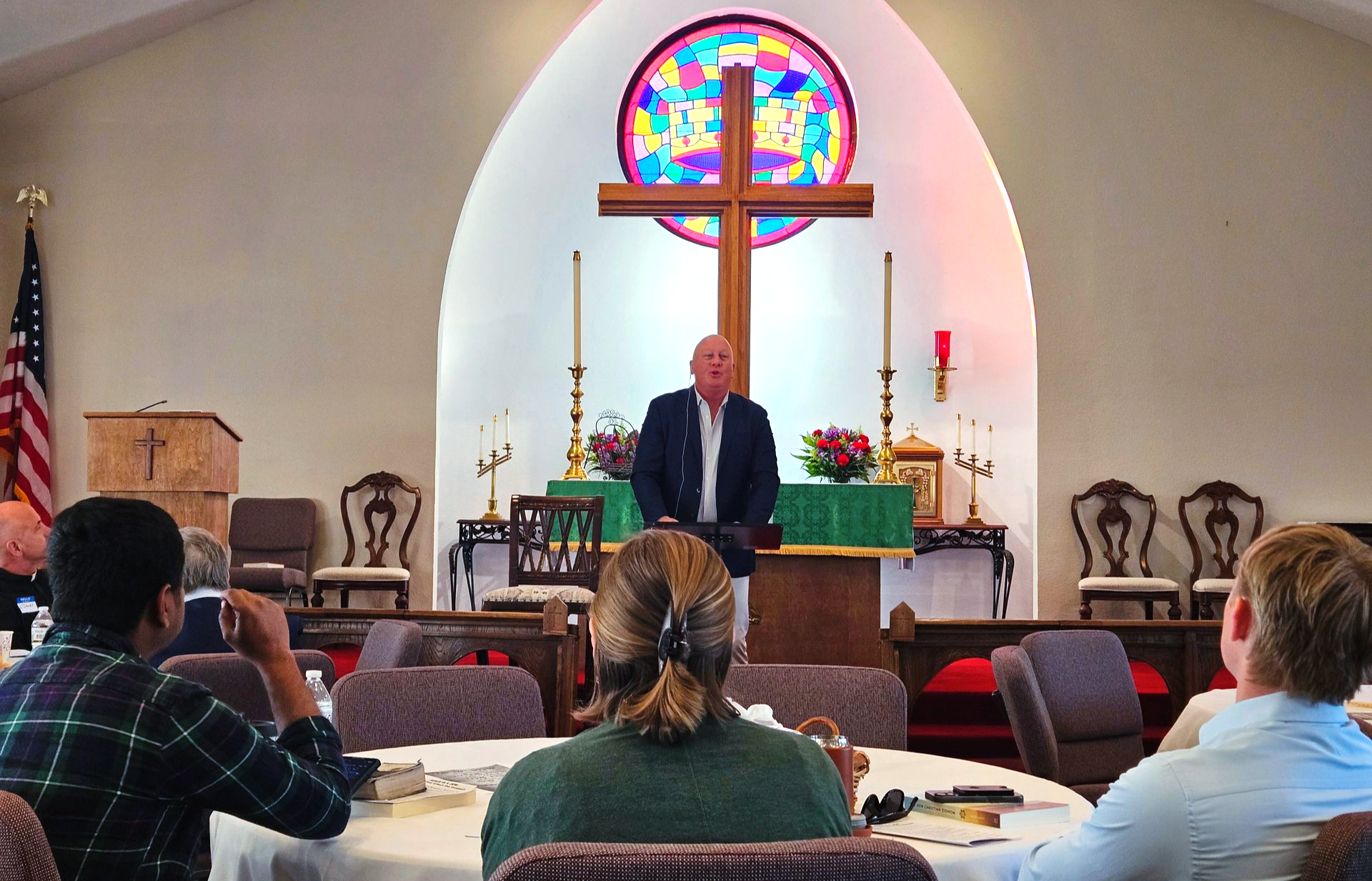
Editors note: This talk was given at the Jesus is a Jew Conference held in Rowlett, Texas, on Oct 21, 2026. It is shared here with the speaker's permission.
Replacement Theology and Early Negligence
Once upon a time, I had little regard for Israel and for the Jewish people. As a pastor, I've been trained in replacement theology. And I was not a dogmatic supersessionist, which is the notion that the church has superseded Israel or the church's triumph over Israel, or the church has replaced Israel. I was not a rank-and-file dogmatic supersessionist. I just didn't care, couldn't care less, had no interest in Jews or Israel. You might say that I was committing the sin of omission rather than the sin of commission. I was passive. I was even negligent, sometimes even had a sense of contempt for the Jewish people.
And as a young pastor, I went to church world conferences where I was told that it was the church and only the church that played a central role in God's redemptive plan for the world. I was told, wherever you see the word Zion in the Bible, it's not talking about Jews or Israel, it's talking about us, the church. My negligence to understand God's covenant and choice of Israel was partly rooted in jealousy. And I thought to myself, if the Jews are chosen, what does that make Gentile saints? Chopped liver? Does it make them chosen-ish?
I didn't understand it, didn't comprehend it, and didn't want to search out truth. I naively thought that if the Jews are God's chosen people, that somehow God was playing favorites. I wrongly thought that God was interested in them more than he was interested in the nations. And I became jealous.
Distinctions Without Favoritism
I didn't read into the scriptures like Deuteronomy 10:17 where it says, "For the Lord your God is a God of gods and Lord of lords, the great, the mighty and the awesome, who is not partial." God is not partial to anyone. I failed to understand what Peter was talking about in Acts 10:34—Peter opened his mouth and said, "Of truth I perceive that God is no respecter of persons, but in every nation that fears him, he works righteousness, they are accepted by him." I failed to understand what Paul was saying in Romans 2:11 where he said God does not show favoritism.
I didn't understand that God does not play favorites, but he does make distinctions. And God has made a distinction between light and darkness, the holy and the common, between righteousness and unrighteousness, between male and female. And he's made the distinction between Israel and the nations. Just as the tribe of Levi was chosen to be the servant priest tribe to the other 11 tribes, he chose Israel to be the servant priest nation to all the nations of the earth. And in Isaiah 49:6, it says, "I will also make you a light to the Gentiles, that my salvation may reach to the ends of the earth." So Israel became the light of revelation. Through them they brought God's moral law to the nations.
The Mystery of the Gospel
But in my passive negligence, I failed to see what Paul the Apostle called the mystery of the gospel. And if you had asked me 25 years ago, "What's the mystery of the gospel?" I would have said, "I have absolutely no idea what that is." Paul explained it in Ephesians 3:1–6: "For this reason I, Paul, a prisoner of Christ Jesus on behalf of you Gentiles—assuming that you have heard of the stewardship of God's grace that was given to me for you, how the mystery was made known to me by revelation, as I have written briefly. When you read this, you can perceive my insight into the mystery of Christ, which was not made known to the sons of men in other generations as it has now been revealed to his holy apostles and prophets by the Spirit. This mystery is that the Gentiles are fellow heirs, members of the same body, and partakers of the promise in Christ Jesus through the gospel."
I didn't see that. I didn't understand that God allowed his own people to be broken off that he might bring in the nations. It was always in the heart of God to bring in the nations. So because of my jealousy, born out of the misconception that God was playing favorites with Israel, I never understood the gravity of what Paul said to a mainly Gentile audience in the church in Ephesus. Paul said in Ephesians 1:3–4, "Blessed be the God and Father of our Lord Jesus Christ, who has blessed us in Christ with every spiritual blessing in the heavenly places, even as he chose us in him before the foundation of the world." So a Gentile from the nations who comes to Jesus, they have been chosen before the foundations of the world. God chose Israel out of love; God chose the nations out of love.
Because of jealousy, I had no desire to see the Holy Land. As a young pastor, I got several invitations. Whenever there was a war in Israel, the Israeli government would invite pastors—no expenses, just come and see the land. And I would tell my friends who were going on the trip, "Why would I want to go to Israel if I can't walk with Jesus here on this soil? What difference does Israel make? What difference does that land make?" I turned down every trip.
In my sermons at that time, over 20 years of preaching, I glossed over the fact that Jesus was a Jew. I thought that he had died on the cross and then after the resurrection, converted to Christianity. The Jewishness of Jesus played no significant role in my preaching. I thought, he's just Jewish, he's really just a Christian. In those 20 years of confusion and neglect, if there was a conference on the Jewishness of Jesus, I would have never signed up, I would have never come.
Discovering Jewish Roots and Family History
What makes my story even more complicated is that I was born a Jew. My father's name is Zebulun. He was born to Orthodox Jewish parents. And in Los Angeles, California, when my father Zebulun was five years old, my grandmother Rose had a vision of Jesus on a cross. And she went to a rabbi, and the rabbi said, "It's a nightmare. Don't pursue that dream." A few days later, as she's walking with my five-year-old father Zebulun through the streets of LA, she hears music coming from a building, she goes into a church, and for the first time in her life she hears the gospel, and she responds and became a believer.
Her parents at that time—my great-grandparents—had fled the Kishinev pogrom in Kishinev, Russia in 1903. Their immigration papers show they came through Ellis Island in 1904. That's how quickly they got out of Russia. It was the Easter pogrom where Orthodox priests were running through the streets screaming "kill the Jews," and many of my great-grandparents' family members perished in the Easter pogrom. So they thought you could have converted to anything—Buddhism, Islam, Hare Krishna—but why Christianity? So they prayed the death prayer over my grandmother, and they never spoke to my grandmother again. To my great-grandparents, Jacob and Celia, she was dead to them.
My dad was killed by a drunk driver when I was three. So my mother went to work and my Jewish grandmother raised me. On Jewish holidays, she would send food to her family. She would send food during Purim and Passover, but never received any word back. So I was raised on kreplach and Jewish humor. The challah bread on my grandmother's table was always covered with a white napkin. We sang music from the Liberated Wailing Wall in those days.
I grew up in that Jewish environment, and I was the eldest of 28 grandchildren.
When my grandma was passing away, she put her hands on my head and blessed me and said, "I have family in Israel who fled Kishinev, Russia. They went to Israel. I want you to go there and connect with your family." That was her dying prayer.
I forgot about that prayer. I forgot about my Jewish roots. I went to undergrad in theology and Bible, got a master's degree in Christian education, and became a pastor.
So my heart towards Israel was rooted partly in jealousy and partly in offense to see the pain of my grandmother's rejection from her family.
A Divine Calling to Israel
So what changed, you might ask? Well, I always say visions are caught, not taught. And I firmly believe that the Holy Spirit tugged on your heart to be here today. I believe you're here by a divine appointment. The issue of Israel and the Jewish people is such a hot-sided issue today, and many of our Christian colleges, seminaries, and universities have gone back to preaching replacement theology, supersessionism. And yet you pushed through all of this and you came.
I always say things start with a burden, and then they turn into a vision, and then you have to have a third component, which is daring. So when you saw the ad about this conference, you got a burden, and then it turned into a vision: "I think I want to go to this thing." But then a third requirement is daring. You had to have the courage to come here today. And so when it came to the Jewishness of Jesus, I had none of this. I had no burden to know and understand. I had no vision outside of the theological box I built around Jesus. I had no daring to push past my misguided theology to understand how the Jewishness of Jesus affected the gospel and affected my pastoral ministry.
This all dramatically, supernaturally, changed in the summer of 2002, when I was a pastor in Mobile, Alabama. We had a school and a daycare – 800 students. I was in my office not thinking about my Jewishness or about Israel. I was probably writing a budget for the school.
And suddenly the Holy Spirit came into my office, and the Lord spoke deeply into my heart: "You're a Jew. Go to Israel and find your family."
And I was undone. I sat at my desk, just weeping.
I walked out of my office, and my secretary said, "What happened to you?" And I said, "I don't know, but I'm a Jew, and I'm going to Israel to find my family."
Connecting with Lost Relatives
The next morning after this event, my secretary walked into my office and said, "Pastor Fruh, I think you should read this letter." I opened the letter. It was from the Israeli government. It was the time of the Intifada. There were no tourists in Israel, and they were inviting 100 pastors to go to Israel free of charge.
I called the number, and two weeks after this event, I got on an El Al flight. As I was checking it, the ticket agent said, "So, I think you might like this ticket." He gave me a first-class seat. I said, "God, you have a dramatic sense of humor."
I called my grandmother's family and talked to her cousin, my dad's cousin, David. After my tour of Israel, I rented a car, I drove down to his house outside of Tel Aviv, and he said, "Who are you?" I said, "I'm Aaron. I'm Rose's grandson." He said, "That's impossible. Rose? There is no Rose." I said, "She's Celia's daughter." He said, "There is no Rose." He called his sister in Tel Aviv. She said, "Put Aaron on the line." She said, "Aaron, I've been waiting 50 years to tell this story. I lived with your great-grandmother when I was a student at UCLA. She told me of another daughter named Rose, and I was never to tell the Israeli family about it."
Restoring Sacred Traditions
My first trip to Israel, what I came away with was the table. I went home and I said, "From here on out, I'm going to gather my family around a table." And for the last 24 years, my family has eaten an evening meal together every night because the table became so vital.
On my second trip to Israel, I saw a poster that said, "May you receive the blessing of Ephraim and Manasseh." It's a picture of a father blessing his sons with the blessings of Ephraim and Manasseh. I came home, I started blessing my children—laying hands on my three daughters and my son, and blessing my children. I wrote a book called The Forgotten Blessing and taught our church the importance of verbally blessing your children with that Jewish blessing. When I was resigning from the church in 2017 after 25 years, a young family said, "Pastor Fruh, the two most significant things you ever did here: you taught us about the importance of returning to the table and the importance of blessing our children."
So once upon a time, I was a supersessionist. Once upon a time, I had no regard for the Jewish people. But God, through the Holy Spirit, changed my heart, changed my life.
Aaron David Fruh is the president of Israel Team Advocates International, a non-profit organization that engages with professors and students on Christian college campuses on the issue of Israel through its conference arm, the Redwood Coalition. He is the weekly host of the Israel and You podcast.
This talk from the Jesus is a Jew conference was transcribed with an AI-assisted note taker and edited by a human.
Blessed by this post? Ready to sow into the work of CMJ? No gift is too small. we are blessed by your partnership.