Messiah the King, Shepherd of Israel

That God himself would come down to gather Israel and the nations is foretold by the prophet Ezekiel
This sermon from Christ the King Sunday - Year A - was preaching at All Souls Anglican Church in Jacksonville, Florida.
Psalm 95
One hundred and one years ago, Pope Pius XI called for a new mass to celebrate the reign of Christ. It was only a few years after the end of World War I. The Great War was supposed to be the war to end all wars. And yet, Pope Pius saw some key world leaders and wannabes making alarming political maneuvers.
In Rome, Prime Minister Benito Mussolini consolidated power and became dictator of Italy. Not long after the death of Vladimir Lenin, Joseph Stalin was positioning to take control of Russia’s government.[1] In Germany, freshly out of prison, Adolf Hitler published Mein Kampf and was reorganizing the Nazi party.[2]
In this global political atmosphere, Pope Pius declared a new church feast day to remind the nations that “not only private individuals but also rulers and princes are bound to give public honor and obedience to Christ.”
Many other traditions – including Anglicans – took the cue from our Roman Catholic brothers and began celebrating Christ the King Sunday the week before Advent.
Across the globe, nationalism is rising again. Many nations are declaring “me first” and are pushing away people that look different than themselves.
In our country, “Christ is King” has become a political club to be swung at people we don’t like, particularly Jews.
Earlier this year, the Associated Press published an article titled “‘Christ is king’ becomes a loaded phrase in US political debates, especially on the right.” An excerpt:
…there are times when the use of the phrase “Christ is king” is unquestionably hostile toward Jews, said a 2025 report by the Rutgers University-affiliated Network Contagion Research Institute.
Analyzing social media postings between 2021 and 2024, the institute reported a dramatic increase of the phrase “Christ is king,” often used as a hate meme targeting Jews. The report lamented this deviation from its historical use as a hopeful, sacred affirmation with biblical roots.
“The weaponization or hijacking of ‘Christ is King’ represents a disturbing inversion of its original intent. Rather than sacralizing shared values, extremists have exploited this religious expression to justify hatred,” the report said.
Just last week, there was a political conference called Christ is King in which the speakers, among many other topics, discussed taking the right to vote away from women.[3]
In January, a young man who had been an honor roll student at a Catholic school was arrested for allegedly setting fire to the synagogue in Jackson, Mississippi. He told the police that it was the synagogue of Satan. At his hearing, he told the judge “ Jesus Christ is Lord.”[4] That was his defense for allegedly setting a Jewish house of worship on fire.
This is all heartbreaking, concerning stuff.
How do we ensure that we here today, on the Feast of Christ the King, are declaring that “Christ is King” in a way that honors Jesus and proclaims his love for all people, Jew and Gentile alike?
First, let’s look at the phrase Christ the King. What does Christ mean? Anointed one. The Anointed One is King. How else might we say that? Messiah is King. Messiah means anointed one. Christ and Messiah are the same word coming from different language roots, Christ from Greek and Messiah from Hebrew.
Messiah, anointed one, is used in the Hebrew scriptures to denote a consecrated prophet, priest, or king. In that sense, David was a messiah. The Persian king Cyrus is called anointed one by God in Isaiah. Elijah was an anointed one. Eventually, in Judaism, Messiah comes to be the term for the long awaited Son of David who will rule Israel from Jerusalem forever.
Messiah is King.
Suddenly, this is a very odd phrase to throw at Jewish person as an attack. An observant Jew would say, “Of course Messiah is King.” There’s a sect of Jews today who believe they know who the messiah is. And they put pictures up of this man with the phrase, Mashiach HaMelech, Messiah the King.
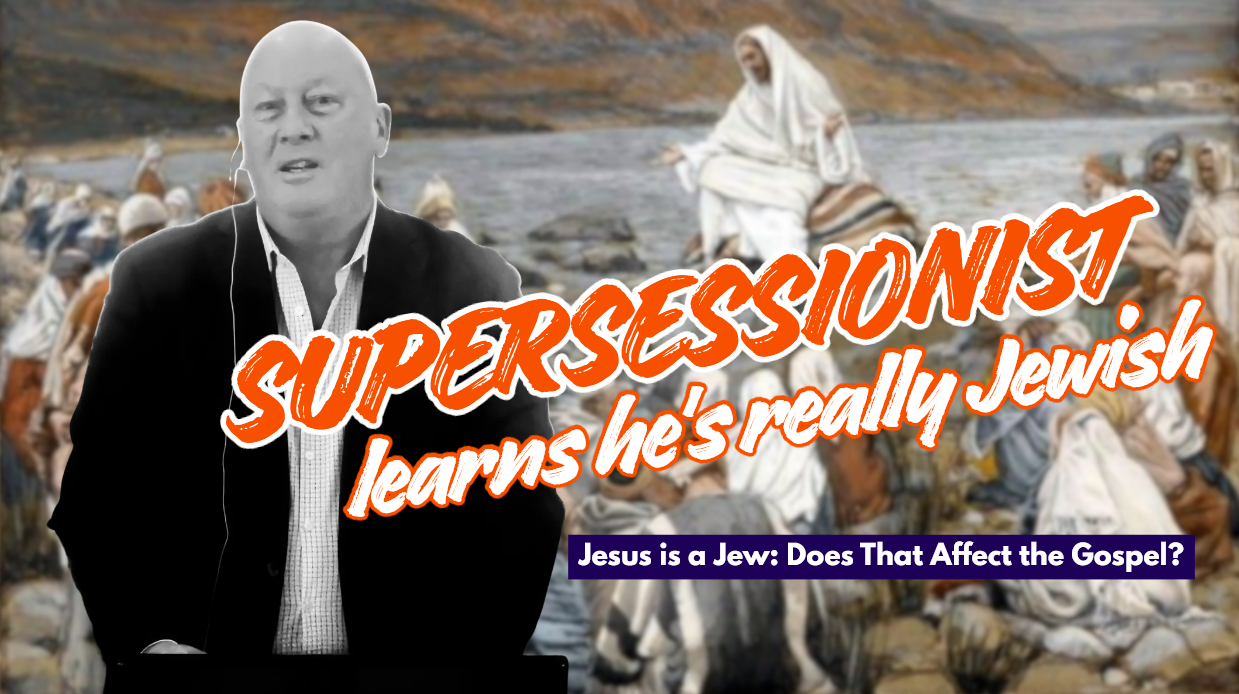
Who do we believe is the Messiah? Who do we believe is the Christ? Jesus of Nazareth. That’s what we Christians mean when we say Christ is King, Jesus Christ is King. Jesus Messiah is King.
Our Jewish neighbors have been waiting for the King of Israel, Son of David to come for at least 3,000 years. We Christians say that he’s come. That is the gospel, the good news: Messiah has come. This good news God “promised beforehand through his prophets in the holy Scriptures, concerning his Son, who was descended from David according to the flesh and was declared to be the Son of God in power according to the Spirit of holiness by his resurrection from the dead, Jesus Christ our Lord.” (Rom 1:2-4)
We Christians also say that Messiah is God. This is where our Jewish and Muslim neighbors, as well as others, push back on us. They say that a man cannot be God. They say this is a Christian invention. Some will blame the Gospel writers. Some blame Paul. And others blame the Greek-speaking 2nd and 3rd century church.
But, as Paul says in Romans 1, God promised it beforehand through his prophets in Holy Scriptures. Ezekiel 34 is one of the places where it is promised.
Today we read from the middle of Ezekiel 34, but to better understand what we read, let’s review the beginning of the chapter.
Ezekiel 34 opens:
The word of the Lord came to me: 2 “Son of man, prophesy against the shepherds of Israel… Thus says the Lord God: Ah, shepherds of Israel who have been feeding yourselves! Should not shepherds feed the sheep? 3 You eat the fat, you clothe yourselves with the wool, you slaughter the fat ones, but you do not feed the sheep. 4 The weak you have not strengthened, the sick you have not healed, the injured you have not bound up, the strayed you have not brought back, the lost you have not sought, and with force and harshness you have ruled them. 5 So they were scattered, because there was no shepherd, and they became food for all the wild beasts. My sheep were scattered; 6 they wandered over all the mountains and on every high hill. My sheep were scattered over all the face of the earth, with none to search or seek for them.
Ezekiel writes from Babylon after the fall of Jerusalem. The temple’s been destroyed. Those not killed in the invasion have been relocated to what is today Iraq.
God has harsh words for the shepherds, that is the leadership of Judah, the kings, princes, priests, scholars. The political and religious shepherds did what people in power often do: They forgot where they came from; they took care of themselves first; they ignored the needs of the little guy, the widow, the orphan, the refugee, the poor, the sick. This grieves the heart of God. There are consequences when we don’t care for the disadvantaged around us. For Judah, it meant invasion, destruction, death, displacement. It meant exile. The people of God were uprooted from their homes in Jerusalem and greater Judah and scattered across the Middle East.
After God chastises the failed leadership, he says an almost surprising thing:
11 “For thus says the Lord God: Behold, I, I myself will search for my sheep and will seek them out. 12 As a shepherd seeks out his flock when he is among his sheep that have been scattered, so will I seek out my sheep, and I will rescue them from all places where they have been scattered on a day of clouds and thick darkness.
I say almost surprising because the whole of the Bible is God coming down to be with humanity, to walk with humanity, to save humanity.
In the Garden of Eden, God came down to spend the evening in fellowship with Adam and Eve. God visited Abraham and Sarah in their camp. God met Hagar and Ishmael in the wilderness. He wrestled with Jacob at Jabbok. He encountered Moses in a burning bush.
So when the leadership fails in Judah, God says, I will come myself and shepherd my people.
13 And I will bring them out from the peoples and gather them from the countries, and will bring them into their own land. And I will feed them on the mountains of Israel, by the ravines, and in all the inhabited places of the country. 14 I will feed them with good pasture, and on the mountain heights of Israel shall be their grazing land. There they shall lie down in good grazing land, and on rich pasture they shall feed on the mountains of Israel. 15 I myself will be the shepherd of my sheep, and I myself will make them lie down, declares the Lord God. 16 I will seek the lost, and I will bring back the strayed, and I will bind up the injured, and I will strengthen the weak…
Did you hear that? The LORD God himself will gather Israel. God himself will feed them. God himself will seek the lost. God himself will tend to the injured and the weak.
I hope this is ringing bells for some of you.
In John 10, Jesus says,
10 The thief comes only to steal and kill and destroy. I came that [the sheep] may have life and have it abundantly. 11 I am the good shepherd. The good shepherd lays down his life for the sheep. …14 I am the good shepherd. I know my own and my own know me, 15 just as the Father knows me and I know the Father; and I lay down my life for the sheep.
Jesus is the good shepherd who comes to gather scattered Judah and Israel. He is God come down to dwell with Israel, to bind their wounds, to feed them, to make the lost found.
This word is still true for the Jewish people. Jesus came to gather the Jewish people from the nations – where they suffer persecution to this day – and give them safety in their ancient homeland. That gathering has been in process for nearly 150 years. But for most Jewish people, they have not yet accepted Jesus as Messiah.
I know most of us here today are not Jewish. Is Jesus also our shepherd? Yes! Later in John 10, Jesus says,
16 And I have other sheep that are not of this fold. I must bring them also, and they will listen to my voice. So there will be one flock, one shepherd. 17 For this reason the Father loves me, because I lay down my life that I may take it up again.
We are the other sheep that God has been collecting into the church for 2,000 years.
Let’s finish the rest of our Ezekiel reading.
16 I will seek the lost, and I will bring back the strayed, and I will bind up the injured, and I will strengthen the weak, and the fat and the strong I will destroy. I will feed them in justice.
17 “As for you, my flock, thus says the Lord God: Behold, I judge between sheep and sheep, between rams and male goats. … 20 “Therefore, thus says the Lord God to them: Behold, I, I myself will judge between the fat sheep and the lean sheep.
In Ezekiel’s time, God is telling both the failed shepherds and those hurt by them that God will judge and God will bring justice. This is true for us as well. Many of us here have suffered some sort of injustice, so sort of hurt, trauma. Sometimes we hurt ourselves. A lot of times we are hurt by others.
God sees. God sees when a sheep is mistreated by the shepherds. God sees when the other sheep mistreat their fellow sheep. God is judge. God will mete out consequences and healing.
In our Matthew reading, we see Jesus pick up on these Ezekiel themes.
31 “When the Son of Man comes in his glory, and all the angels with him, then he will sit on his glorious throne. 32 Before him will be gathered all the nations, and he will separate people one from another as a shepherd separates the sheep from the goats. 33 And he will place the sheep on his right, but the goats on the left. 34 Then the King will say to those on his right, ‘Come, you who are blessed by my Father, inherit the kingdom prepared for you from the foundation of the world.
In the interest of time, we won’t unpack the Son of Man title right now. This is Jesus’ favorite title for himself. Jesus is the Son of Man, he is the king.
Notice that the king here is acting like a shepherd. The King of Heaven is the shepherd of Israel and all the nations. And in this scene he’s sorting sheep from goats.
Shepherds keep sheep and goats together because they herd and feed well together. But when it’s time to harvest milk or wool, when it’s time to settle the flock in for the night, the shepherds would separate the more rambunctious goats from the sheep.[5]
In Matthew 25, Jesus is the great shepherd of the nations of the world. And at the second coming of our Messiah, he will sort through the flock and judge. He is the God of Israel who judges the shepherds and judges the flock.
What is the criteria for sorting the peoples? How we treat Jesus’ brothers. Jesus will tell the unfaithful:
‘Depart from me, you cursed, into the eternal fire prepared for the devil and his angels. 42 For I was hungry and you gave me no food, I was thirsty and you gave me no drink, 43 I was a stranger and you did not welcome me, naked and you did not clothe me, sick and in prison and you did not visit me.’ 44 Then they also will answer, saying, ‘Lord, when did we see you hungry or thirsty or a stranger or naked or sick or in prison, and did not minister to you?’ 45 Then he will answer them, saying, ‘Truly, I say to you, as you did not do it to one of the least of these [my brothers], you did not do it to me.’ 46 And these will go away into eternal punishment, but the righteous into eternal life.”
Notice these are some of the same failures of the shepherds in Ezekiel 34. The failure to care for the hungry and thirsty, to clothe the naked, to care for the sick.
So who are Jesus’ brothers that we are to care for?
There are three main interpretations, and I believe they all have something to tell us.
- Jesus’ brothers are the ministers of the Gospel.[6] Earlier in the Gospels, Jesus says his disciples are his family. We have a responsibility to care for our pastors, our missionaries, our evangelists, especially when they are in need, when they are ill, when they are persecuted.
- Jesus is God come down and become human. In the Incarnation, God becomes our elder brother. And so all humans are Jesus’ brothers and sisters. The church has a long history of seeing all the poor and needy as an opportunity to minister directly to Jesus. So for those of you who care for the homebound, for prisoners, for the hospitalized, the poor and needy, you are offering love and care to Jesus himself.
- Our Messianic Jewish brothers and sisters – Jews who believe in Jesus – remind us that all Jews are related to our Lord. Jesus IS Jewish. He has Jewish DNA for all eternity. We all long to see Jesus face to face. As we wait for his return, we have an opportunity to care for his DNA relatives now.
Antisemitism – hateful words and actions against Jewish people – is high. For the sake of Jesus, we must call out hateful speech when we hear it, and we must offer comfort to our Jewish neighbors. We Christians, of all the peoples of the earth, should be the first to stand up against hateful language aimed at anyone, but especially against Jewish people. Even when they do not agree with us that Jesus is the Messiah of Israel, they are our family. When we minister comfort to them, we minister directly to Jesus our King!
All humanity is scattered. We all have been or perhaps still are lost sheep. This world is a wilderness. Satan, the enemy of our souls, roams around like a lion seeking to eat us alive. Satan uses our sinful nature, the brokenness of this work, sickness, and violence to wound us. But Jesus, the Good Shepherd, lays down his life for us, his sheep.
And this is why Jesus is King. As Paul says,
Messiah Yeshua, 6 Who, though existing in the form of God,
did not consider being equal to God a thing to be grasped.
7 But He emptied Himself—
taking on the form of a slave,
becoming the likeness of men
and being found in appearance as a man.
8 He humbled Himself—
becoming obedient to the point of death,
even death on a cross.
9 For this reason God highly exalted Him
and gave Him the name that is above every name,
10 that at the name of Yeshua every knee should bow,
in heaven and on the earth and under the earth,
11 and every tongue profess that Yeshua the Messiah is Lord—
to the glory of God the Father.
Jesus is King because he died for us. He died for the people of Israel. He died for the Palestinians, for the Ukrainians and the Russians. He died for us Americans and for the peoples of every country in the world.
God came down and became human to die for us and so bind up our wounded hearts, cleanse our selfish souls, bring us home to himself. He comes down even to the depths of death and rises again to shepherd us into resurrection life.
If you are here today and you believe Jesus came and died for your sins and rose from the dead, then you are a sheep who has come home. If you still have questions about this, please talk to the pastors here or to a Christian friend. They want to help you answer the Good Shepherd’s call.
Now, you sheep who know Jesus’ voice. We have a job to do. Jesus says, “Feed my sheep.” After the resurrection, this is what he tells Peter on the banks of the Sea of Galilee. “Feed my sheep.”
We have a call to help him shepherd all the lost sheep home. He tells us, “Go make disciples of all nations.” This is another way of saying, “Go out and help me bring the sheep home.”
These scattered sheep are Jewish and Muslim, atheists and agnostics, Hindus and Buddhists. I’ve been hearing stories of how some of you are ministering to refugees and to disadvantaged youth. You are receiving people coming back to church after a long time.
You are doing the work of the Good Shepherd. Keep doing it. Through these acts of love and kindness, keep declaring to the nations, to Jews and Gentiles, Christ is King. Messiah is King. Jesus, our good shepherd, is the benevolent king. The King wants to bring you home.
Let us pray.
O God, whose Son Jesus Messiah is the Good Shepherd of your people: Grant that, when we hear his voice, we may know him who calls us each by name, and follow where he leads; and equip us to care for our neighbors, both those who know you and those who do not yet know you. May we point them to the Good Shepherd, Jesus, who, with you and the Holy Spirit, lives and reigns, one God, for ever and ever. Amen.
Footnotes
- James McKarns, “The Origins of Christ the King,” The Catholic Echo, November 1, 2024, https://catholicecho.org/2024/11/01/the-origins-of-christ-the-king/ (accessed November 21, 2026).
- United States Holocaust Memorial Museum, “Adolf Hitler and the Nazi Rise to Power, 1918–1933,” Holocaust Encyclopedia, June 23, 2025, https://encyclopedia.ushmm.org/content/en/article/the-nazi-rise-to-power (accessed November 21, 2026).
- Donie O’Sullivan, “In Newly Blue Texas, Far-Right Christian Nationalists Gather to Plan a Future after Trump,” CNN, November 15, 2026, https://www.cnn.com/2026/11/15/politics/christian-nationalists-nick-fuentes-trump (accessed November 21, 2026).
- Arno Rosenfeld, “How an ‘All-American Boy’ Became a Mississippi Synagogue Arson Suspect,” The Forward, January 21, 2026, https://forward.com/news/antisemitism-decoded/799227/stephen-spencer-pittman-beth-israel-arson/ (accessed November 21, 2026).
- Thomas D. Stegman, “Exegetical Perspective on Matthew 25:31–46,” in Feasting on the Word: Preaching the Revised Common Lectionary: Year A, ed. David L. Bartlett and Barbara Brown Taylor, vol. 4 (Louisville, KY: Westminster John Knox Press, 2011), 333.
- Craig S. Keener, Matthew, vol. 1 of The IVP New Testament Commentary Series (Downers Grove, IL: InterVarsity Press, 1997), Mt 25:31–46.
Blessed by this post? Ready to sow into the work of CMJ? No gift is too small. we are blessed by your partnership.