The Isaiah Scroll once was lost, but now can be seen

Bedouin shepherds found it. A bishop sold it. An Israeli agent bought it. Now you can see it up close.
This story was originally published in the Forward. We republish it with permission.
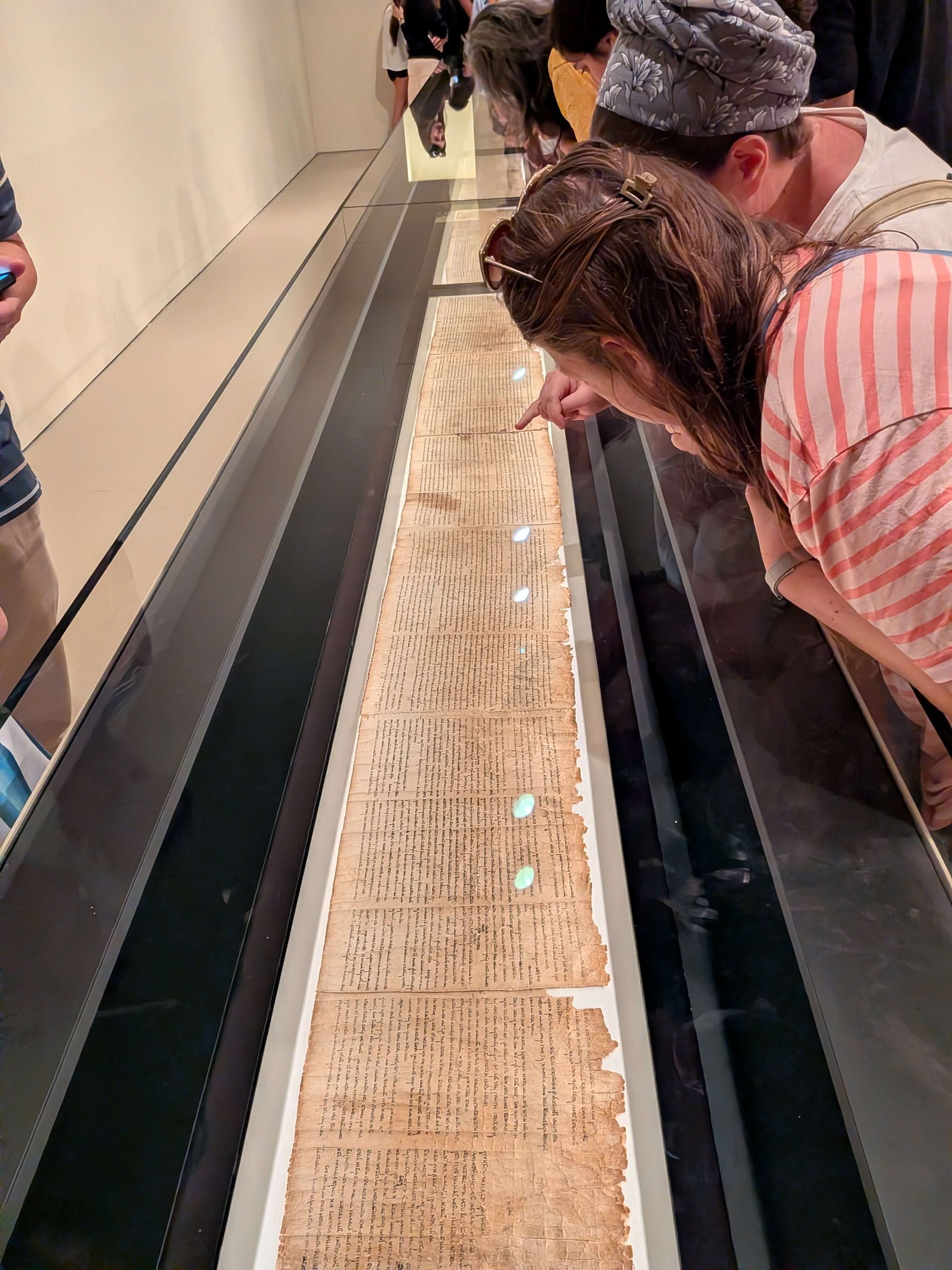
The Great Isaiah Scroll is the only Dead Sea Scroll found intact. Copied more than 100 years before Jesus of Nazareth was born, it contains all 66 chapters, including the sometimes contested climax of the Servant Songs, Isaiah 53.
The magnificent 717-centimeter ancient Isaiah scroll on view right now at The Israel Museum, for the first time in 60 years, is drawing so many people that the museum has set strict guidelines for visitors.
To see the scroll — meaning the original, handwritten, non-facsimile, version that survived for two thousand years in jars hidden in a cave — with your own eyes, all 23 1/2 feet of it, you need to register by 8 a.m.
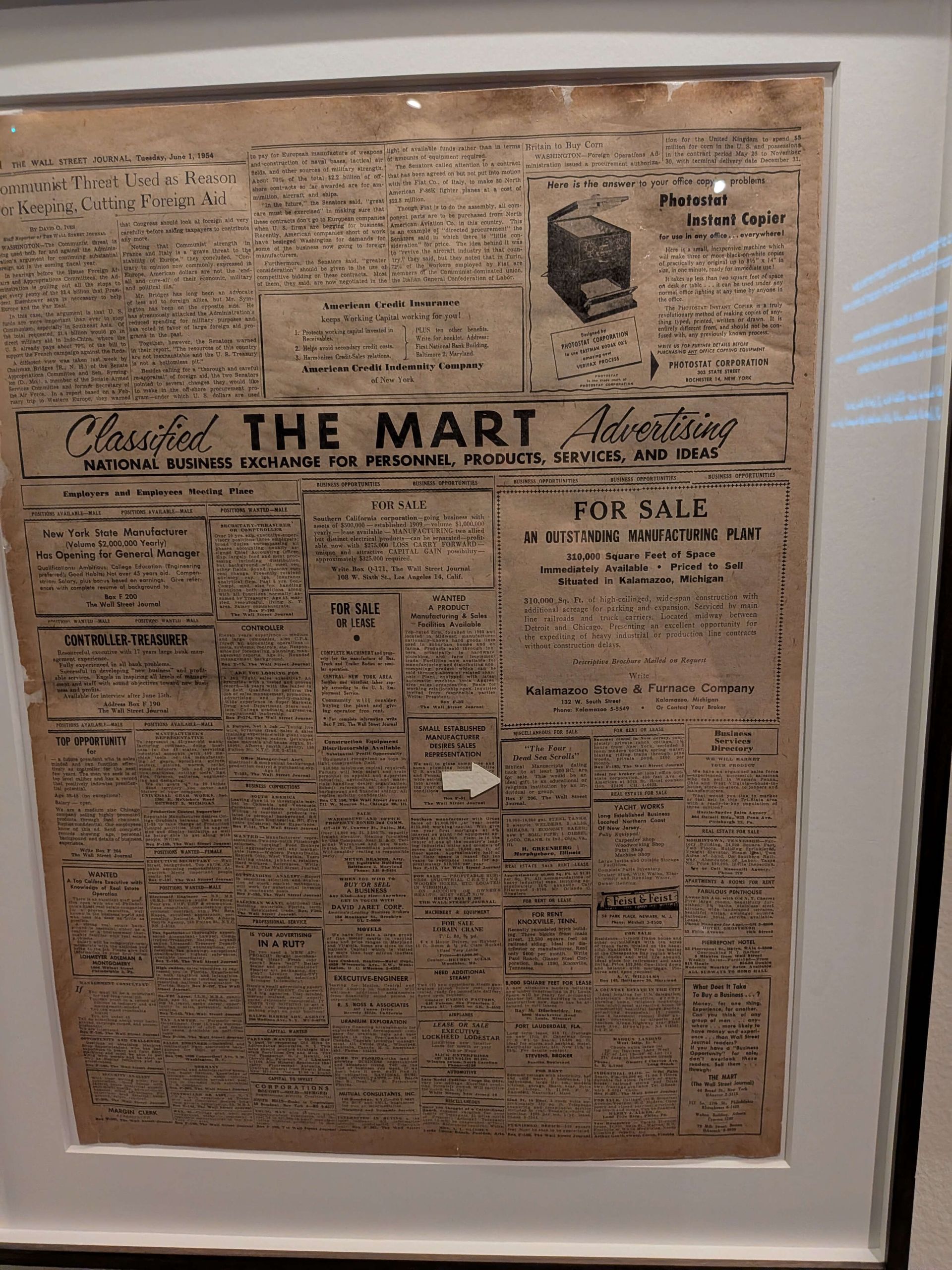
Once you are at the exhibit entrance, you need to wait your turn; you have to watch a film first about the incredible story of how the Isaiah scroll was found by Bedouin shepherds in a remote cave near the Dead Sea, sold to Archbishop Samuel, head of the Syrian Orthodox Monastery of St. Mark in Jerusalem, then read and evaluated by a professor whose son became Israeli military royalty, photographed by an American scholar, sent by the bishop to the U.S. for a tour of several leading universities in the hope of snaring a very high price, and then at long last, clandestinely purchased by an agent hiding that he was representing Israel from a small and seemingly innocuous ad in The Wall Street Journal . Then you have exactly 10 minutes in a temperature-controlled room with the scroll.
There is something spiritual and moving about seeing this gigantic, complete, handwritten scroll that was literally hidden in a cave for millennia. What is remarkable about it, Professor Noam Mizrahi of the Hebrew University in Jerusalem explains in a video you can watch after you check the scroll out for yourself, is first of all its age.
“It is over two thousand years old,” he explains. To be precise, the scroll was written in 125 BCE. The other amazing aspect of it is its fullness — not only are all 66 chapters there, but the Hebrew is written in a full way.
What does that mean, exactly? Consider the first line, “ This is the vision of Isaiah the son of Amotz ,” written in the scroll as “ Yishayahu ben Amotz .” You can see with your own eyes that the original scribe wrote “ Yeshaya ,” and that another, later, scribe, added a letter, the ayin, so that it now reads “ Yishayahu ” as Isaiah is pronounced in today’s Hebrew.
It offers a glimpse into ancient pronunciation, Mizrahi explained. I would add that it also offers a glimpse into editing — writers are never done.
And maybe the Jewish people are never done discussing what the vision of Isaiah is, and what it means. This particular scroll wasn’t a museum artifact in the early days.
“It was in use for at least 100 years,” Mizrahi said — you can tell from the corrections.
But back to that fullness. This is a neatly written scroll of a text so many of us recognize — timeless, the curator Hagit Maoz commented in the video, and about peace, and justice. Maybe my vision is failing, but it was hard to make out psukim, or verses, I knew by heart.
This is not because the handwriting wasn’t neat — each aleph was distinct and perfect — but because the letters are small. I found myself cheating by taking a picture with my phone and enlarging it. Then I felt guilty for wasting a bit of my precious ten minutes on technology.
My group included a woman with a seeing-eye dog. If I could barely make out the letters, what could she see?
But the scroll is not just about seeing. It is about feeling. You can feel that this text is connected to this place. It’s the feeling of being here, of being near something written thousands of years ago by hand, something ours, something whole. There is the feeling that this is where Isaiah roamed, and this is where this incredible book — this timeless piece of Jewish literature — began.
Once the ten minutes are up, visitors are ushered into another room with a copy of the Isaiah scroll enlarged, and with key verses highlighted. There was the dream of peace, I thought as I looked at individual verses — the wolf dwelling with the lamb — and then there is the reality. The other day, I heard a young guy tell a date he had done 600 days of miluim, or reserve service.
I found myself refocusing on the true story of how the Isaiah scroll made it to the public. I couldn’t get enough of the details.
From shepherds to The Wall Street Journal
When Bedouin shepherds chased a sheep sometime in early 1947, they reached challenging terrain across from the northwest rim of the Dead Sea that no one else was willing to enter.
They heard a piece of pottery in a cave crack.
Curious, they went inside and found seven scrolls inside jars in the cave. They took them out, not knowing what they were. The museum explains that the bishop, who purchased the scrolls, consulted Eleazar Sukenik of the Hebrew University of Jerusalem, who immediately realized he was looking at an ancient Isaiah scroll and copied some sections; he told the bishop he was interested in purchasing the scrolls, both the ones in his possession and those still with the shepherds.
According to the Israel Antiquities Authority website when Sukenik learned of the scrolls’ discovery, he set out to investigate their significance. “Braving Arab-Jewish tensions, he travelled to meet the Armenian dealer at the British divided military zone of the Jerusalem border. In this clandestine meeting, the dealer held up a fragment of leather for the professor to examine. As Sukenik peered through the wire, he recognized the ancient writing.”
Incredibly, on Nov. 29, 1947, on the very same day as the United Nations vote on the Partition Plan, the historic vote which led to the establishment of Israel, Prof. Sukenik bought three of the seven scrolls.
Meanwhile, the bishop decided to get another opinion on his four scrolls, from an American scholar in Jerusalem who was the first to photograph them. By March 1948, convinced of the scrolls’ value and concerned for their safety as the War of Independence raged, the bishop had his assistant take the scrolls to a bank in Beirut, where they were held in a safe.
In Dec. 1948, the bishop headed to Beirut, picked up the scrolls, when gone to New Jersey, where he hoped to sell them.
Echoes of history
Learning of the scrolls, I couldn’t help but think of the great Yiddish poet Avrom Sutzkever and the Paper Brigade in Vilna. As the Nazis tried to annihilate the Jewish people, great writers risked their lives to save Jewish literature and culture, to hide it for the future. It’s a repeating theme in Jewish history — the military battle and the cultural battle, continuing at the same time.
Sadly, Professor Sukenik lost a son to battle in the war.
Then the professor himself died.
But the family’s passionate connection to the Isaiah scroll was not over. The professor’s other son, Yigael Yadin, who would become both a major scholar and a military leader, was in New York in the early 1950s and happened to read a small advertisement in The Wall Street Journal offering four scrolls. He guessed that the Isaiah scrolls his father wanted had been spirited off to the United States; he wired Israel to tell the new government to find $150,000. (Here, some Jewish philanthropy helped.)
It turns out that the bishop’s representative had tried to sell — to the Library of Congress, the Walters Gallery in Baltimore, Duke University, and The University of Chicago — but all refused. He failed because Jordan claimed the scrolls belonged to it because of where they had been found, while Israel claimed they were theirs because of cultural heritage.
Yadin hired an agent to conceal that Israel was the actual buyer, and the four were purchased on July 1, 1954. On July 9, the Isaiah scroll was separated and spirited to Israel by plane, with other planes escorting it for safety.
The Israel Museum built the Shrine of the Book to house the scroll, and it was opened to the public in 1955. But in 1968, the real scroll was replaced with a very good facsimile for the scroll’s continued safety.
Now, in honor of the museum’s 60th anniversary, the real thing is on view. My advice — don’t miss it.
---
“A Voice from the Desert: The Great Isaiah Scroll” is on view at the Israel Museum through Oct. 3.
Blessed by this post? Ready to sow into the work of CMJ? No gift is too small. we are blessed by your partnership.