40th Omer: Jesus, the Son of Man, is enthroned in heaven

The Ascension of Messiah shows us Jesus is King of Kings and our Great High Priest
There is a tradition in Judaism called counting the omer (sheaves). It is drawn from Leviticus 23:15-16:
15 “You shall count seven full weeks from the day after the Sabbath, from the day that you brought the sheaf of the wave offering. 16 You shall count fifty days to the day after the seventh Sabbath. Then you shall present a grain offering of new grain to the Lord.
This counting goes from the Feast of First Fruits[1] to Shavuot (the Feast of Weeks or Pentecost from Greek for fifty). It’s considered a mitzvah (commandment) because God said to do it. The details of how to count and what prayers to pray vary by denomination or context. Here’s what Chabad, Reformed Judaism, and My Jewish Learning have to stay about this mitzvah.
On the way to 50, some in Judaism pause at 33 – Lag [2] baOmer – to honor the life a second century rabbi – Rabbi Shimon bar Yochai – by among other things, burning bonfires.
Should the followers of Jesus be counting too?
Yes! Let’s see what we’re counting.
Acts 1 and 2 give us the beginning of a timeline:
1Dear Theophilos: In the first book, I [Luke] wrote about everything Yeshua set out to do and teach, 2 until the day when, after giving instructions through the Ruach HaKodesh (Holy Spirit) to the emissaries (apostles) whom he had chosen, he was taken up into heaven.
3 After his death he showed himself to them and gave many convincing proofs that he was alive. During a period of forty days they saw him, and he spoke with them about the Kingdom of God.
4 At one of these gatherings, he instructed them not to leave Yerushalayim (Jerusalem) but to wait for “what the Father promised, which you heard about from me. 5 For Yochanan (John the Baptizer) used to immerse people in water; but in a few days, you will be immersed in the Ruach HaKodesh!”
…
1The festival of Shavu'ot arrived, and the believers all gathered together in one place. 2 Suddenly there came a sound from the sky like the roar of a violent wind, and it filled the whole house where they were sitting. 3 Then they saw what looked like tongues of fire, which separated and came to rest on each one of them. 4 They were all filled with the Ruach HaKodesh and began to talk in different languages, as the Spirit enabled them to speak. (Acts 1:1-5, 2:1-4 CJB, emphasis added)
Jesus resurrects from the dead on Feast of Firstfruits. He spends 40 days with his disciples, proving that he is alive and teaching them more about the Kingdom of God.

John J. Parson at Hebrew4Christians.com points out that all of Jesus’ post-resurrection appearances occurred during the counting of the omer:
- Day 1: On the Feast of Firstfruits, that is Resurrection Sunday, Yeshua appeared to
- Mary Magdalene (Mark 16:9; John 20:16-18),
- some other women (Matt. 28:5-10),
- then to Simon Peter (Luke 24:34; 1 Cor. 15:5),
- the two on the Road to Emmaus (Luke 24:13-32) and
- later that evening to the disciples (Mark 16:14; Luke 24:33-39; John 20:19-23).
- Day 8: Jesus appeared to the eleven, as this time Thomas was with them (John 20:26-29). Thomas the skeptic touches Jesus’ wounds and exclaims, “Adonai v elohai!” (My LORD and my God).
- Unknown day: He appeared to the disciples as they went back to their fishing jobs (John 21:1-14).
- Unknown day: Yeshua appeared to 500 (1 Cor 15:6) and then to James, the half-brother of our Lord Yeshua (1 Cor 15:7).
- Day 40 (Mem baOmer[3]): On Iyar 25, or the 40th day of the Omer, Yeshua ascended into heaven from Bethany. He commanded his followers not to leave Jerusalem until they received “the promise of my Father” and were “clothed with power from on high.” (Luke 24:44-53; Acts 1:9-11; Eph 4:8).
- Day 50: On Shavuot, they were all filled with the Holy Spirit. Why did flames of fire appear? Listen to “Seeing God’s voice to Israel & the nations,” where I explain the connections between the giving of the Torah at Sinai and outpouring the Holy Spirit in Acts 2.
What's so important about the Ascension?
Let’s focus on Day 40. Ascension Day is a principal feast on the Christian calendar. It’s considered as important as Christmas, Easter, and Pentecost. Why does it matter?
Let’s not get bogged down on the difference in counting, whether one counts from the second day of Unleavened Bread or from the Sunday after Passover. The question is why is the Ascension of Jesus important enough to merit a feast day – whether on a traditional Church calendar or a Messianic Jewish calendar?
Let’s go back to a phrase Jesus said to Caiaphas the high priest and the Sanhedrin at his trial. All three synoptic Gospels record this, but we’ll look at Mark’s version for its clarity:
61 …Again the high priest asked [Jesus], “Are you the Christ (Messiah), the Son of the Blessed (God)?” 62 And Jesus said, “I am, and you will see the Son of Man seated at the right hand of Power, and coming with the clouds of heaven.” 63 And the high priest tore his garments and said, “What further witnesses do we need?
Caiaphas asked Jesus plainly if he’ s the Messiah, Son of God. The Davidic king is called Son of God based on the coronation song in Psalm 2, where God says, “You are my Son; today I have begotten you.” In Mark, Jesus answers just as plainly, “I am,” but then he adds more information.
Jesus called himself Son of Man around 80 times in the Gospels (Matt, 32 times; Mark, 14; Luke, 26; John, 10).[4] This was his preferred title. What was Jesus communicating?
The Son of Man goes back especially to Daniel 7, where Daniel records a vision.
9 “As I looked, thrones were placed, and the Ancient of Days took his seat; his clothing was white as snow 13 … and behold, with the clouds of heaven there came one like a son of man, and he came to the Ancient of Days and was presented before him. 14 And to him was given dominion and glory and a kingdom, that all peoples, nations, and languages should serve him; his dominion is an everlasting dominion, which shall not pass away, and his kingdom one that shall not be destroyed.
First, Daniel sees God, whom he calls the Ancient of Days. But Daniel sees not one but two thrones! Then he sees “one like a son of man” ascending with the clouds. Son of man (ben-adam in Hebrew and bar-enosh in Aramaic) is a Semitic idiom for a human being. So Daniel sees a human ascending into heaven who is given an eternal kingdom over all the nations. The implication is that this human is given a throne next to God himself.
Jesus combines the language of Daniel 7 with Psalm 110, where David writes:
The LORD says to my Lord: “Sit at my right hand, until I make your enemies your footstool.” 2 The Lord sends forth from Zion your mighty scepter. Rule in the midst of your enemies!... 4 The Lord has sworn and will not change his mind, “You are a priest forever after the order of Melchizedek.”
In Psalm 110, we see someone sitting at the right hand of God ruling as a king and also priest, like the mysterious figure Melchizedek in Genesis 14.
So when the Sanhedrin asks Jesus of Nazareth if he’s the messiah, he says yes, and I’m also the human who sits next to God in heaven and rules all of creation.
The notion of a heavenly eternal, even divine, Messiah was not foreign to Judaism. The theological ideas of the messiah and the Son of Man developed separately but the expectations merged into the same figure for some Jews centuries before Jesus was born. [5]
When Jesus resurrects and then ascends, the apostles run with the message that Jesus is this divine Messiah has been given all authority in heaven and earth and sits at the right hand of the Father (i.e. Ancient of Days). Not only does he rule and reign but he intercedes for humanity as the Great High Priest [6] before God (Acts 2:33; Acts 7:55-56; Rom 8:34; Col 3:1; Heb 1:3; 8:1, 10:12, 12:2, 1 Pet 3:22).
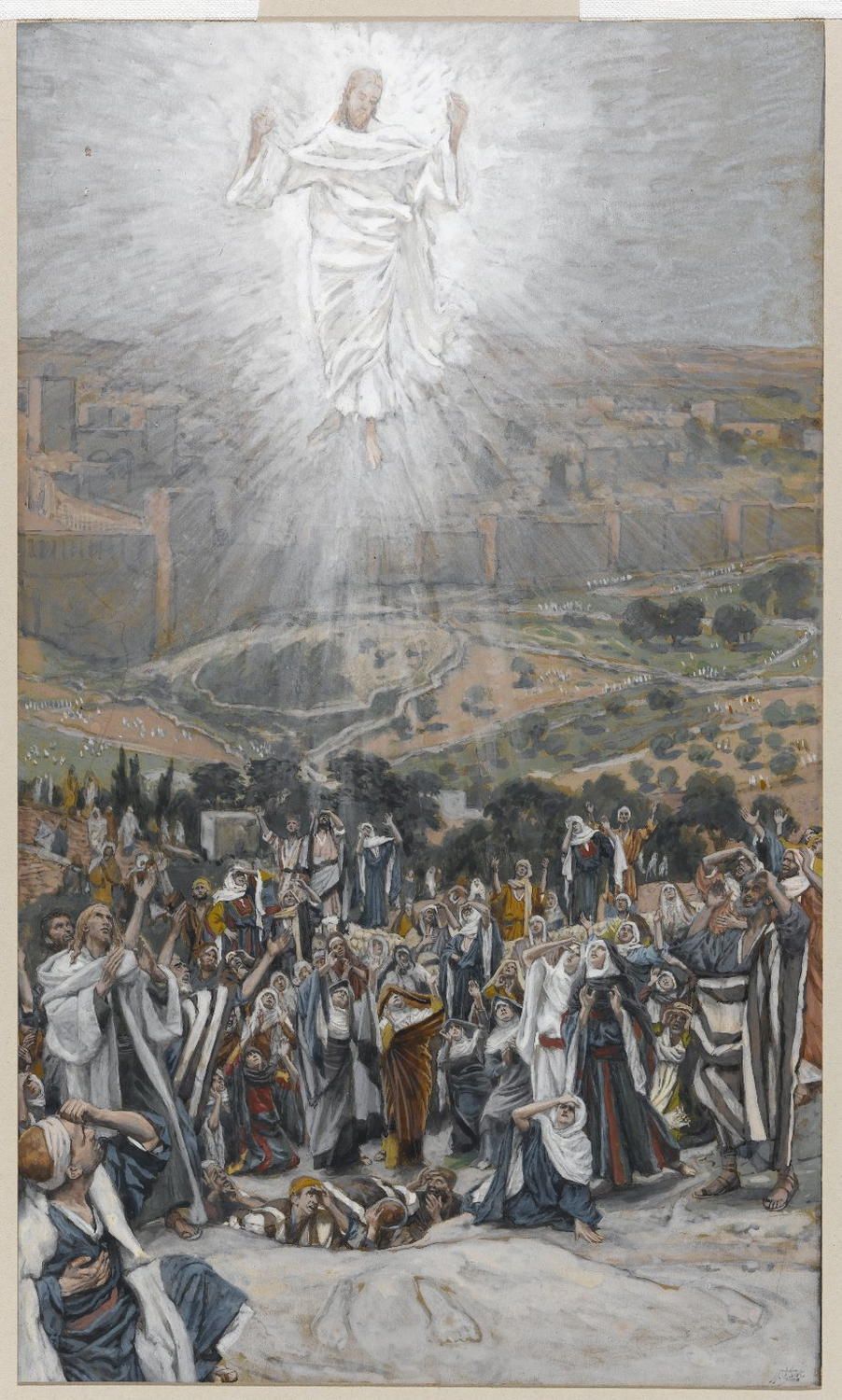
Ascension Day is Jesus’ enthronement day
It is the day that the Father “highly exalted him and bestowed on him the name that is above every name, so that at the name of Jesus every knee should bow, in heaven and on earth and under the earth, and every tongue confess that Jesus Christ is Lord, to the glory of God the Father” (Phil 2:9-10, quoting Isa 45:23).
So next year, when you’re counting the omer, pause at 40 to remember that Jesus our great high priest, the king of kings, sits next to the Ancient of Days praying for you.
A prayer: El-Shaddai, whose only-begotten Son our Lord Yeshua Messiah ascended into heaven: May our hearts and minds also there ascend, and with him continually dwell; who lives and reigns with you and the Holy Spirit, one God, for ever and ever. Amen. [7]
Footnotes
- When do we start counting? Leviticus 23 says ““You shall count seven full weeks from the day after the Sabbath…” The Pharisees read “the day after the Sabbath” as the day (Nisan 16) immediately after the High Sabbath that is the first day of the Feast of Unleavened Bread (Nisan 15). The Sadducees read it as the Sabbath (Saturday) after the Passover holiday, meaning Feast of First Fruits would always be a Sunday. Modern Judaism starts counting from Nisan 16, the interpretation passed down from the Pharisees. Christians count from Easter Sunday, because that’s when Jesus rose from the dead, “the firstfruits” of the resurrection (1 Cor 15:20,
23). That Nisan 16 (second day of Unleavened Bread) was the when Feast of First Fruits was celebrated in the Second Temple Period is attested to by Philo (The Special Laws, II, 162) and Josephus (Antiquities of the Jews, Book 3, Chapter 10, Section 5 (3.250)). Best we can tell when we align the various calendars used by Jews and Romans, the years when Nisan 16 fell on a Sunday (thereby aligning with both Pharisee and Sadducee interpretation) were AD 30 or 33. Evidence of a lunar eclipse on Passover AD 33 make that the likeliest candidate for the year of Jesus’ death and resurrection. (Humphreys, C. J., & Waddington, W. G. (1992). The Jewish Calendar, A Lunar Eclipse and the Date of Christ’s Crucifixion. Tyndale Bulletin, 43(2), 331–356.
https://doi.org/10.53751/001c.30487)
- When counting with the Hebrew alphabet, 33 is lamed gimmel (LG), vocalized LaG.
- When counting with the Hebrew alphabet, the letter mem (M) has a value of 40.
- Walter A. Elwell and Barry J. Beitzel, “Son of Man,” in Baker Encyclopedia of the Bible (Grand Rapids, MI: Baker Book House, 1988), 2:1983.
- Daniel Boyarin, The Jewish Gospels: The story of the Jewish Christ, (New York: The New Press, 2012) discusses this development at length.
- The writer of Hebrews begins to unpack the Messiah’s priestly role, especially in
Heb 4:14-5:10;
6:19-10:18
- The Collect for Ascension Day with some language Hebraicized, Anglican Church of North America, Book of Common Prayer (2019), (Huntington Beach, CA: Anglican Liturgy Press), 613.
Blessed by this post? Ready to sow into the work of CMJ? No gift is too small. we are blessed by your partnership.